

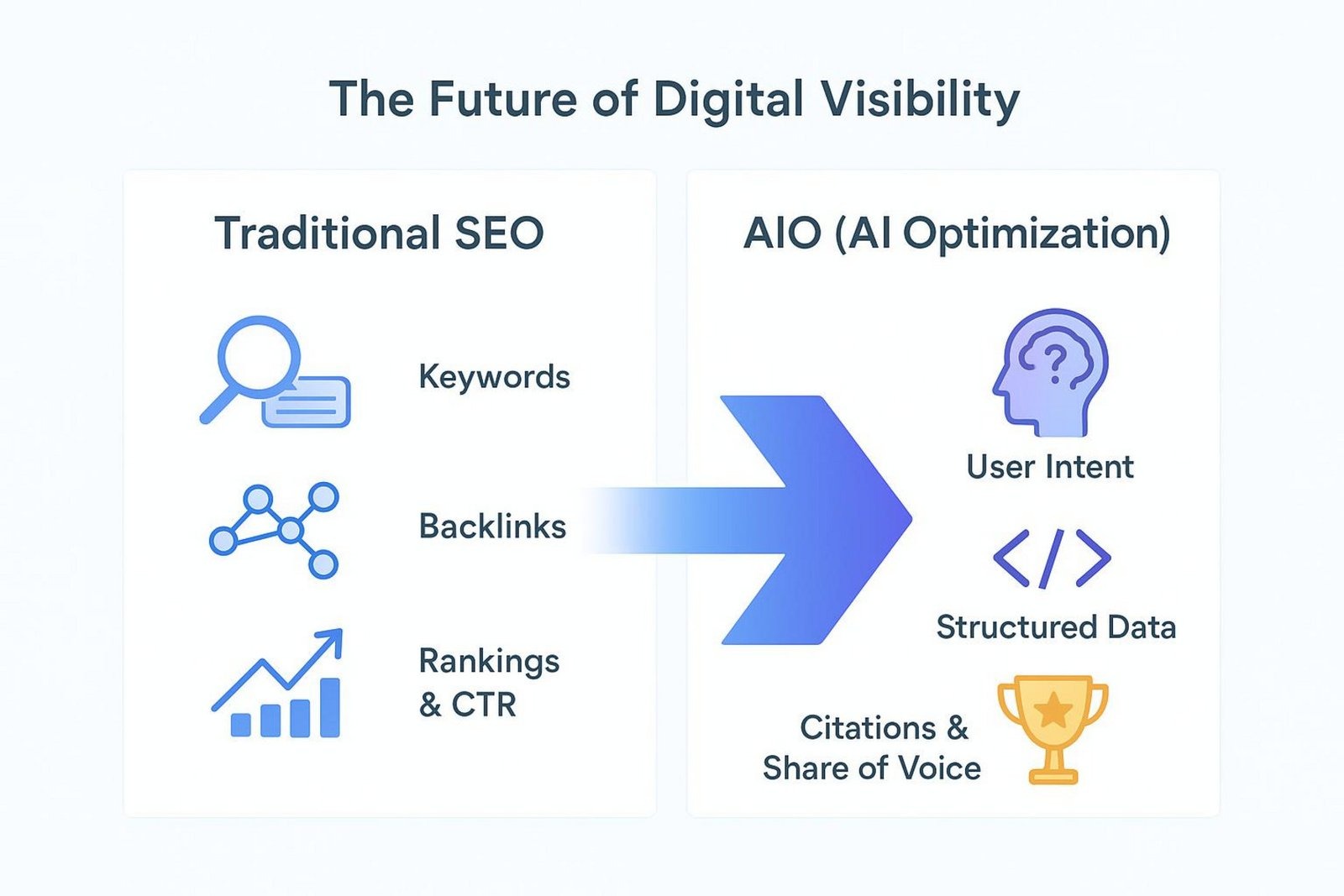
AI Optimization (AIO) is becoming the new standard of SEO because the way people interact with information has shifted from “hunting for links” to having a conversational “answer-seeking” experience.
Classic SEO, which focused on ranking a website at the top of a list of blue links, is no longer enough in a world where AI assistants like ChatGPT, Claude, and Google’s Gemini pull information together into instant, zero-click summaries.
To stay visible, brands must shift focus from just being “found” by crawlers to being “understood” and quoted by large language models (LLMs) as trusted sources.
This change is a major turning point in digital marketing. As of early 2026, traditional search volumes are falling while AI-driven discovery is rising quickly. For businesses and creators, the goal is no longer only winning a specific keyword; it is about gaining a place inside the AI’s “knowledge graph.”
By adopting AIO – AI Optimisation – New SEO, organizations put themselves in a position where, when an AI tool is asked for a recommendation or explanation, their brand is the one being mentioned, instead of being stuck on page two of a declining search index.
What Is AIO and How Does It Differ from Traditional SEO?
How Has SEO Changed in the Era of AI?
In the early 2000s, SEO was a mainly technical job. Visibility followed a clear formula of site structure, keyword density, and the number of backlinks. If you cleaned up your meta descriptions and collected enough links, you could usually reach the first page.
The AI era has replaced this simple path with a smart, summary-focused layer. Users no longer want to click through ten websites to find a recipe or compare B2B software; they want a clear summary delivered right away.
This change means visibility is no longer just about where you appear in the results. It is about how AI reads and rates your brand’s authority. Traditional SEO aimed to please search engine crawlers that indexed pages; AIO aims to “teach” AI models to represent your brand correctly.
Many marketing specialists now say: if SEO was about being found, AIO is about being understood. The AI does more than link to you; it talks on your behalf.
Key Features of AIO Versus SEO
The differences between traditional SEO and AIO are clear and structural. Traditional SEO leans heavily on keywords and backlinks to drive traffic. AIO focuses more on user intent and “AI-readability.” In AIO, content needs to be “modular”-broken into smaller, clearly structured pieces that an AI assistant can easily scan, evaluate, and put together into a useful answer. This scanning process, called parsing, is how tools like Microsoft Copilot or Perplexity decide which content deserves to be cited in a final reply.
The way we measure success has also changed. In the past, we tracked rankings and click-through rates (CTR). In the AIO age, we watch “citation probability” and “share of voice” inside AI-generated summaries.
Recent data shows that when a brand is cited in an AI Overview, it gets 35% more organic clicks compared with times when it is left out. This makes AIO an important extra layer on top of current SEO strategies rather than a full replacement.
Why Is AIO Becoming the New Standard of SEO?
AI Search Integration and New Algorithms
AI in search engines is not a future idea; it is already here. Tech companies spent nearly $250 billion on AI development in 2024 alone, which pushed fast rollout of Search Generative Experiences (SGE). Algorithms have moved past simple pattern matching into deep semantic understanding. They now use systems like BERT and MUM to grasp the subtleties of human language, so “keyword stuffing” is not just useless-it can hurt your visibility.
Because AI models are trained on huge datasets, they favor content that shows consistent narratives across the web. If your brand is described in a similar way on trusted sites like Forbes, Reddit, and your own blog, the AI gains “confidence” in your authority. That confidence is what leads the AI to pick your content as the main answer to a user’s question.
Google Search Updates and Zero-Click Results
One of the main forces behind the AIO shift is the rise of “zero-click” searches. Reports from late 2024 and 2025 showed that around 60% of Google searches now end without any click to an external website. Google’s AI Overviews and featured snippets give the answer directly on the results page, solving the user’s need right away. For many publishers, this has caused large drops in referral traffic—sometimes between 25% and 50%.
To stay alive in this “zero-click” world, brands must aim for “Position Zero.” This means structuring content so it becomes the main source the AI uses to build its summary. However, simply adopting universal templates isn’t enough; to truly compete on the global stage, companies partner with https://non.agency/en/ to develop strategies rooted in local market intelligence and deep technical expertise.
Being the cited source in an AI answer is the new “ranking #1.” It builds brand trust and keeps the brand visible even when users do not visit the site itself. This transition from chasing clicks to securing authority is now a priority for technology companies looking to secure their future in international search.
Rise of Semantic Search and User Intent
The way people search has changed almost overnight. Instead of typing short phrases like “best marketing platforms,” users now ask long, specific questions: “Which B2B marketing platform is best for a startup with under $1M in revenue and a focus on LinkedIn automation?” AI search engines are very good at reading the “why” behind these questions. They combine results live and answer in natural language.
AIO meets this need by focusing on semantic depth. This means mapping out all the related concepts and entities around a core topic instead of chasing one high-volume keyword. By covering a topic in full using “content clusters,” a website sends a clear signal to the AI that it is a strong, in-depth authority on the subject, which greatly improves the chances of being cited in conversational results.
AIO Content vs Traditional SEO Content: What Sets Them Apart?
Relevance and Personalization Over Rankings
Traditional SEO content was often written to hit a certain word count or keyword use level to please an algorithm. AIO content is built for relevance and personalization. AI search is dynamic; two users rarely see the exact same answer because the AI shapes its reply based on each user’s context and past behavior. So AIO content must be highly relevant and rich in context to meet different user needs.
In this new standard, “information gain” matters a lot. AI models are trained to skip repetitive, “thin” content that only repeats what is already on the first page of results. To stand out in the AIO age, your content must bring something new-such as original research, unique data, or genuine expert opinions-that the AI cannot easily find elsewhere. This originality is what makes your content worth citing.
How AI Optimized Content Satisfies Both Bots and Humans
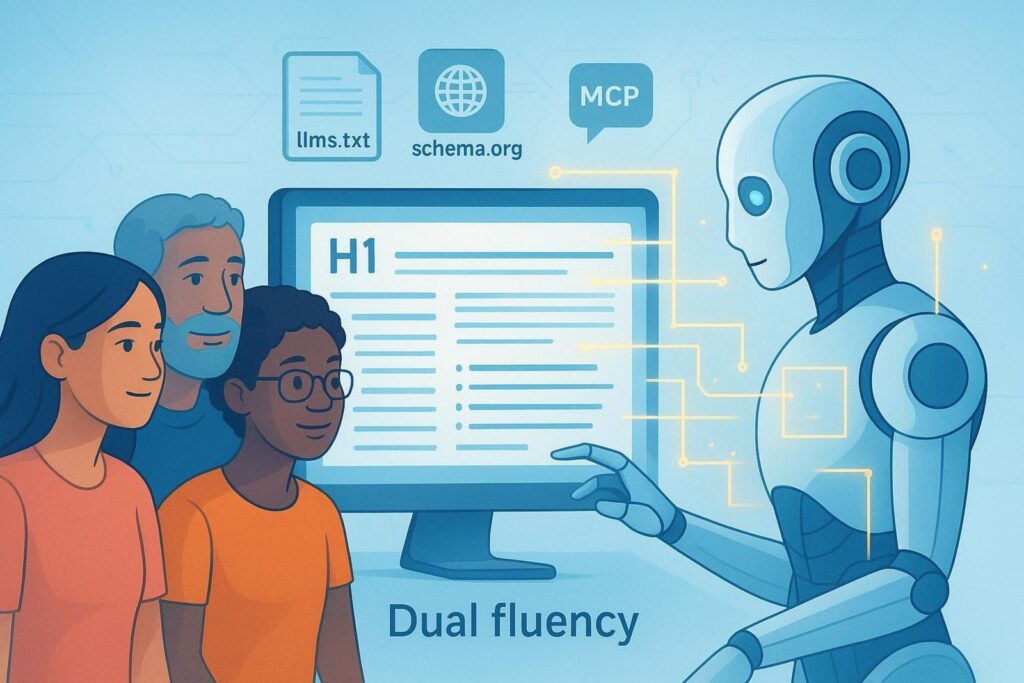
Modern content creation needs “dual fluency.” This means writing in a way that connects with human readers while also being easy for machines to read and break down. Human-focused writing inspires trust and emotion, which is key for turning visitors into customers once they land on your page.
Machine-focused writing uses clear metadata, schema markup, and strong heading structures to help AI grasp the purpose of each section.
AIO content often follows a “mini-course” layout: a short introduction, followed by sections like “What is X?”, “How does it work?”, and “Why does it matter?” This simple, logical flow helps AI assistants lift specific sections word-for-word into an answer box.
By writing with clear intent, you help the AI “learn” about your organization and present you in a positive and accurate way.
What Are the Core Elements of Effective AIO?
Topical Authority and Deep Content Clusters
AI algorithms prefer websites that show deep knowledge in a specific area. Instead of posting isolated articles, AIO focuses on building “content clusters.” You start with a broad “pillar page” that links to many “cluster pages” that explore subtopics in detail. This connected structure shows the AI you are a key source on that subject. Studies indicate that a well-organized content cluster can increase citation chances by up to 40%.
Topical authority also means staying up to date. AI systems give priority to “fresh” content, especially for topics that change quickly. Regular updates with new data, case studies, and trends tell the AI that your information is still current and helpful for users right now.
Intent-Driven Writing and Structured Data
Strong AIO content starts with writing for the real “why” behind a search. This often means using question-based subheadings (H2s and H3s) that sound like how users talk to their AI assistants. For example, instead of a heading that says “Product Features,” use “How Does This Software Improve Team Productivity?” This style helps the AI match the user’s question directly with your answer.
Structured data, or Schema markup, acts like a map for the AI. By using JSON-LD scripts to label your content as a “Product,” “FAQ,” or “Article,” you give the AI clear hints about what your text means. Pages with rich schema are 36% more likely to appear in AI-generated summaries and citations.
<script type=”application/ld+json”>
{
“@context”: “https://schema.org”,
“@type”: “FAQPage”,
“mainEntity”: [{
“@type”: “Question”,
“name”: “How Does This Software Improve Team Productivity?”,
“acceptedAnswer”: {
“@type”: “Answer”,
“text”: “Our software improves team productivity by automating repetitive tasks, centralizing communication, and providing real-time analytics on project progress.”
}
},{
“@type”: “Question”,
“name”: “Is this platform suitable for small businesses?”,
“acceptedAnswer”: {
“@type”: “Answer”,
“text”: “Yes, our platform is designed to be scalable and offers a pricing tier specifically for small businesses and startups with under 20 employees.”
}
}]
}
</script>
Trustworthiness, EEAT, and Credibility Signals
Google’s EEAT framework-Experience, Expertise, Authoritativeness, and Trustworthiness-acts as the gatekeeper for AIO success. AI systems look for signs that a real, qualified human is behind the content. This includes detailed author bios, links to credentials, and references to trusted sources. Content that clearly shows expertise is cited over four times more often by AI systems than content without these signals.
<script type=”application/ld+json”>
{
“@context”: “https://schema.org”,
“@type”: “Article”,
“headline”: “Why AIO Is Becoming the New Standard of SEO”,
“author”: {
“@type”: “Person”,
“name”: “Jane Doe”,
“url”: “https://www.example.com/about/jane-doe”,
“jobTitle”: “Senior SEO Strategist”,
“worksFor”: {
“@type”: “Organization”,
“name”: “Digital Insights Inc.”
},
“sameAs”: [
“https://www.linkedin.com/in/janedoe”,
“https://twitter.com/janedoe_seo”
]
},
“publisher”: {
“@type”: “Organization”,
“name”: “Digital Insights Inc.”,
“logo”: {
“@type”: “ImageObject”,
“url”: “https://www.example.com/logo.png”
}
}
}
</script>
Trust also comes from consistency. AI models check if your brand’s name, contact details, and services match across platforms, including social media and review sites. In the AIO age, reputation management covers your whole digital footprint, not just your website.
Natural Language and Content Design for AI Parsing
AI assistants do not read a page straight through. They break it into usable parts. To help with this, content should be easy to scan. Use short paragraphs, bullet lists, and comparison tables. These elements turn complex ideas into clear chunks that AI can quickly reuse in a user answer.
Simple, natural language also beats heavy jargon. AI systems are becoming better at reading like humans and prefer clear, direct writing. Avoid large blocks of text and unnecessary symbols, so the machine can easily recognize your content as relevant and high quality.
How to Adapt Your Content Strategy for the AIO Era
Identifying User and Machine Intent
Adapting to AIO starts by moving beyond old-style keyword lists. You need to spot the exact questions your audience is asking AI tools. Platforms like AnswerThePublic, and the “People Also Ask” sections in search results, help you map out the natural, conversational questions your users have.
Understanding how machines interpret those questions is just as important-knowing how AI “thinks” helps you frame your answers in the format most likely to be chosen for a summary.
This research should guide a content calendar that balances evergreen authority content with timely topics. By being one of the first to publish a clear, structured answer to a new industry question, you can claim early “space” in AI summaries before your competitors even react.
Optimizing for AI-Generated Search Snippets and Answer Boxes
To stand out in AI Overviews, you need “snippable” content. This means giving straight, one- to two-sentence answers to common questions near the top of your articles. These “answer blocks” should be complete on their own, so they still make sense when taken out of context. Setting these up as Q&A sections or “Key Takeaways” boxes can greatly increase your chances of being featured.
Using lists for step-by-step guides and tables for comparisons also makes your content easy to extract. AI engines prefer structured layouts because they can show users a clean, organized answer without having to re-write your information.
Designing Content That Future-Proofs Visibility
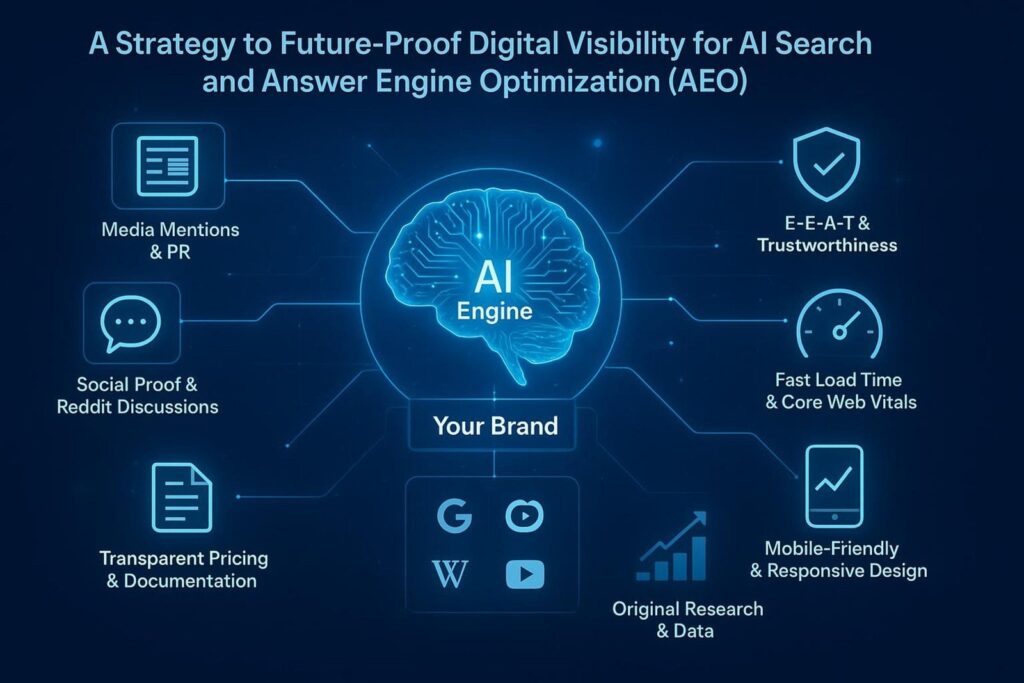
Future-proofing visibility in the AIO age means building a brand presence that stretches beyond your own site. Since AI pulls data from many sources, your plan should include strong PR and mentions on respected media outlets. If AI tools see your brand in places like TechCrunch, Reddit, and The Wall Street Journal, they are far more likely to recommend you as a trusted option.
You also need a technically strong website. Fast load times (under 3 seconds) and mobile-friendly design are basics you cannot skip. If an AI crawler finds a slow or hard-to-use site, it may ignore your content and choose a faster, easier source instead.
Common Challenges and Risks When Moving to AIO
Pitfalls of Relying on Outdated SEO Tactics
The biggest risk today is holding on to an old SEO playbook. Tactics like exact-match keyword stuffing or buying cheap backlinks are now punished by AI-driven algorithms. These tricks make it harder for AI to read your real intent and authority. Many brands that have not adjusted to AIO are already seeing their organic traffic crash as users skip traditional search results and go straight to AI answers.
Another trap is producing “thin” content. In the past, you could rank by publishing many short, low-value blog posts. Today, AI models label this as “generic junk” and skip it in favor of deeper, well-researched content. Quality has clearly won over quantity.
Maintaining Human Creativity and Brand Voice
As brands use AI tools to help write and optimize content, they risk losing their human personality. Generative AI is strong at summarizing, but it cannot truly create original thought leadership or unique viewpoints. If your content sounds exactly like a generic AI summary, users have little reason to visit your site.
The answer is to use AI as a helper, not a full replacement. Human experts need to bring in real experiences, stories, and clear brand voice into every piece. This human-led approach is what builds long-term loyalty and keeps your brand recognizable and trusted in a flood of AI-generated text.
What Are the Benefits and Long-Term Impacts of AIO on SEO?
Improved Search Visibility and Engagement
While classic click-through rates may be going down, the traffic coming from AI referrals is usually much higher quality. Data shows that AI search traffic converts at about five times the rate of traditional organic traffic. This is because the AI summary has already “pre-sold” the user; by the time they click your link, they are further along in their decision and more ready to take action.
Being cited by an AI also works like an automatic endorsement. When ChatGPT or Gemini names your brand as the answer to a problem, it creates instant trust and brand recall. This “halo effect” helps your performance across many marketing channels, not just search.
Staying Competitive Through Adaptation
Early adopters of AIO are currently taking over the most valuable space in search: the AI Overview. By adapting now, you set the baseline other players must catch up to. As AI search grows toward a projected 14% of global traffic by 2028, brands already seen as “AI-trusted” will enjoy compounding gains.
Over time, AIO helps businesses build stronger, more direct relationships with their audiences. By focusing on niche expertise and loyal readers instead of chasing random keywords, you build a brand that people actively look for by name, no matter how search interfaces change.
Frequently Asked Questions About AIO and the Future of Search
Can AIO and AEO Work Together?
Yes. AEO (Answer Engine Optimization) is basically a smaller part of AIO. AIO is the wider strategy to stay visible across AI systems, while AEO focuses on becoming the direct “answer” to a question. They overlap heavily in areas like structured data and intent-based writing. Using both means your brand stays visible whether users are doing broad research or asking a quick, specific question.
Should Small Businesses Prioritize AIO Now?
Yes, small businesses should act on AIO now to avoid becoming invisible online. AI search often reduces the advantage of big backlink profiles and instead highlights real expertise. This gives small companies with deep knowledge in a niche a rare chance to outrank larger brands. Putting time and budget into AIO today is one of the best ways to protect your practice or store against falling traditional search volumes.
How Do You Measure AIO Success?
Measuring AIO success needs a fresh set of metrics. Track your “citation frequency”-how often AI platforms mention your brand-and monitor referral traffic from AI-focused browsers like Perplexity.ai or ChatGPT.
Also, watch “branded search lift,” which shows that people are beginning to search for your brand name after seeing it in AI answers. Tools like Google Search Console still help, but you should add AI-specific tracking solutions on top.
Key Takeaways for Embracing the AIO Standard in SEO
The move to AIO is not a simple tweak; it is a major shift in how digital influence works. To succeed in 2026 and later, businesses need to treat every piece of content as data that “trains” AI about who they are and what they do. This calls for clear communication, strong topic coverage, and proven expertise.
The brands that will lead the next decade are those that stop trying to game the system and start focusing on speaking clearly to both humans and machines.
Beyond the technical side, the future of search rewards authenticity. As the web fills with raw AI-generated text, human-led thought leadership and original research will become the strongest competitive advantage.
By combining the technical basics of AIO with a real, trustworthy brand voice, you can keep your organization visible, credible, and human in a search landscape driven more and more by AI. The era of the “blue link” is fading; the era of the “authoritative answer” has arrived.